

The origins of the ever-elusive mathematical constant known as pi (π) dates all the way back to ancient times, from the Babylonians to the Egyptians and Greeks. Archaeological evidence suggests that Babylonians used a value of 3 for pi; the Egyptians and Greeks believed the value to range around 3.14.
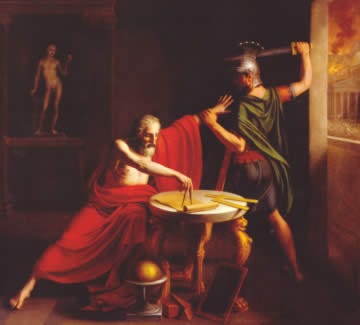
The first accurate calculation of pi (π) was made around 250 BC by the Greek mathematician Archimedes. His calculation gave (π) a value of 3.14159. Archimedes was well known for his mathematic abilities, but he was also a renowned engineer using his knowledge of physics to design weapons, including a catapult used to protect his home city Syracuse from the invading Roman Army. Yet, Archimedes was eventually killed by the Romans during the Second Punic War in 212 BC, when the Roman General, Marcus Marcellus, and his forces captured the city.
More than 300 years after Archimedes’ death the Greek historian Plutarch said of him:
“He placed his whole affection and ambition in those purer speculations where there can be no reference to the vulgar needs of life.”
You may be asking, “how does this discussion relate to classical thought?” First, it is pi day, and therefore seems timely. Yet more importantly, it provides us an opportunity to discuss the significance of studying the ancients. Some of the greatest minds of the Renaissance and the Enlightenment were directly influenced by the work of Archimedes. Two thousand years after Archimedes’ time, during the Renaissance and 1600s, mathematicians looked again at his work. For example, Galileo Galilei and Sir Isaac Newton were inspired to study mathematics and physics based on Archimedes discoveries.

Unfortunately, many of Archimedes’ texts have been lost to antiquity. However, there are some surviving works that managed to find their way into print. In 1544, Leonardo da Vinci was given access to selected handwritten copies. Archimedes compiled, The Method, a text he requested be included in the Library of Alexandria. He sought to make his findings available to disclose how he performed mathematics. He sent it to Eratosthenes, stating:
“I presume there will be some current as well as future generations who can use The Method to find theorems which we have not discovered.”
Therefore, this pi (π) day as we take a moment to marvel at the remarkable mind of Archimedes, the father of pi (π), we can also appreciate how classical thought and critical thinking has been essential in understanding science and mathematics from the ancients, to the renaissance, on through to the enlightenment, and beyond.
Resource: "Archimedes." Famous Scientists. famousscientists.org. 1 Jul. 2014. Web. 3/14/2023 <www.famousscientists.org/archimedes/>. Revised 18 Jul. 2018.